
African venture capital in Q2 2026 reflects divergence. Funding for African startups edged higher in the first half of 2026, reaching $1.44 billion compared with $1.42 billion a year earlier, according to TechCabal Insights. However, trackers disagreed significantly on the actual number but came to consensus on direction: fewer deals and capital consolidating in later-stage and asset-backed structures.
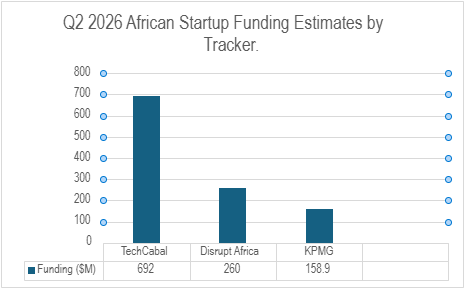
Disrupt Africa’s tracker recorded about 38 African tech startups raising a total of $ 260 million in the second quarter of 2026, 40% down from the $ 427 million raised in the same period of 2025. TechCabal Insights' figures, by contrast, put the quarter far higher: a half-year split of $749 million in Q1 and $692 million in Q2, with $818 million in equity, $614 million in debt, and $9 million in grants for the full first half. Meanwhile, KPMG's Venture Pulse, found VC-backed companies raising $158.9 million across 143 deals in Q2, describing overall investment as “soft,” as investors become selective. The gap between $158.9 million and $692 million for the same quarter underscores how much these snapshots depend on what counts as "venture" and which deals get disclosed.
The composition of capital is the real story.
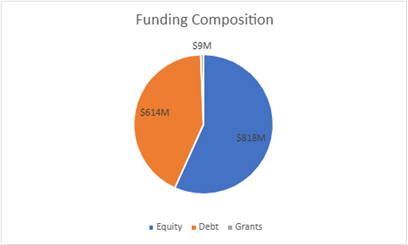
Debt and hybrid instruments have displaced pure equity as the dominant funding mechanism. AU-Startups' analysis notes that debt financing has increasingly displaced equity as the primary instrument for many African startups, a trend particularly evident in e-mobility, where deals tripled from seven in H1 2025 to twenty-one in H1 2026, with companies like Spiro, GoCab, MAX, and Roam securing financing against motorcycles, batteries, vehicles, or receivables rather than selling ownership. Startup Map Africa frames this as the defining shift of the year. Africa: The Big Deal's H1 tracking, split almost evenly between equity and debt, marks a departure from 12–18 months ago when equity's share sat above 70%, driven by infrastructure-heavy companies borrowing against physical assets instead of diluting founders.
Deal count is contracting even where dollar totals hold up.
Startup Map Africa reports just 146 disclosed rounds in H1 2026 versus 252 a year earlier, despite the total dollar figure edging up. AU-Startups adds an early-stage signal: seed-stage deals dropped by 60% in Q2, a trend that could severely impact the pipeline of future Series A candidates, with fewer than 10% of African startups currently advancing to Series A. This mirrors the broader private-capital picture from AVCA-linked data, which found rounds below $500,000 falling from 52% of deals in 2021 to just 19% in H1 2026, with the count of startups raising above $100,000 dropping to its lowest level since at least 2021. The same report notes venture deal count specifically fell 34% to 102 transactions in H1 2026, the lowest H1 level since 2020, even though it still accounted for 48% of all private-capital deal volume.
Geography and sector patterns held roughly steady.
Egypt, Kenya, Nigeria, and South Africa continue to anchor the bulk of disclosed capital, consistent with Q1's pattern. Egypt's resurgence masks the influence of one exceptional transaction, attracting $327 million, ahead of Nigeria's $254 million and Kenya's $126 million.
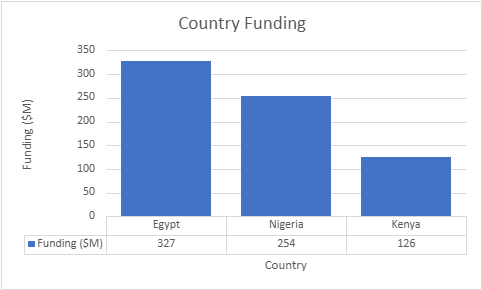
Egypt's rise was driven largely by electric mobility startup Spiro, which raised a $327 million financing package comprising $270 million in equity and $57 million in debt. That single financing package accounted for virtually all of Egypt's reported funding, illustrating how one transaction can reshape continental rankings.
Kenya's drop to third place generated attention across the continent. Despite a slowdown in venture funding, the country's innovation ecosystem continues to benefit from experienced founders, international investors, active accelerators, and a pipeline of technology companies. As Joseph Oloyede, Head of Ventures at TechCabal Insights, observed in response to the Ouut, “Kenya remains one of Africa's 'Tier-1' or 'Big Four' startup ecosystems despite temporarily slipping in the funding rankings,” he said.
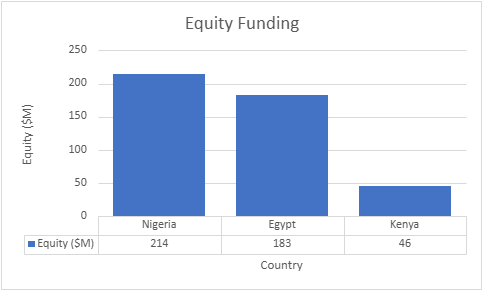
Tomi Davies, venture capitalist and former president of the African Business Angel Network (ABAN), argued that the headline rankings obscure the underlying picture. "Nigeria's $214 million in equity outweighs Egypt's $183 million, backed by a broader base: 40 ventures raised above $100,000, against Egypt's 26 and Kenya's 25. Kenya's equity figure, just $46 million, is the number that matters.”
Recovery remains concentrated among later-stage companies
Total funding increased, but the benefits are not evenly distributed. The report indicates that a small number of large financings accounted for a significant share of all capital raised, while many early-stage founders continued to face difficult fundraising conditions.
The global venture capital markets, where investors have shifted away from growth strategies towards businesses demonstrating sustainable revenue growth and clearer paths to profitability.
KPMG's Venture Pulse Africa Q2 2026 similarly notes that investors are prioritising disciplined capital deployment, stronger governance, and commercially proven business models over speculative growth. The result is a market where growth-stage companies with established traction are attracting capital more readily than startups seeking seed or Series A investment.
The H1 2026 report suggests that African venture capital is concentrating on fewer deals as early-stage equity checks are harder to close. The challenges in Q2 2026 will be whether this recovery broadens to include more early-stage companies and a wider range of African markets, rather than remaining concentrated in the established venture hubs.


